
No matter where you are—on the road, at a park, or short on gear—this efficient, no-equipment workout gives you a full-body challenge that fits into any schedule. It pairs high-intensity burpee sets with progressively longer runs for a cardio- and strength-focused session you can complete anywhere. If you enjoy minimal-equipment routines, explore more workouts in our workouts category here.
This post contains affiliate links. If you purchase through a link on this page, we may earn a small commission at no extra cost to you.
Workout Description
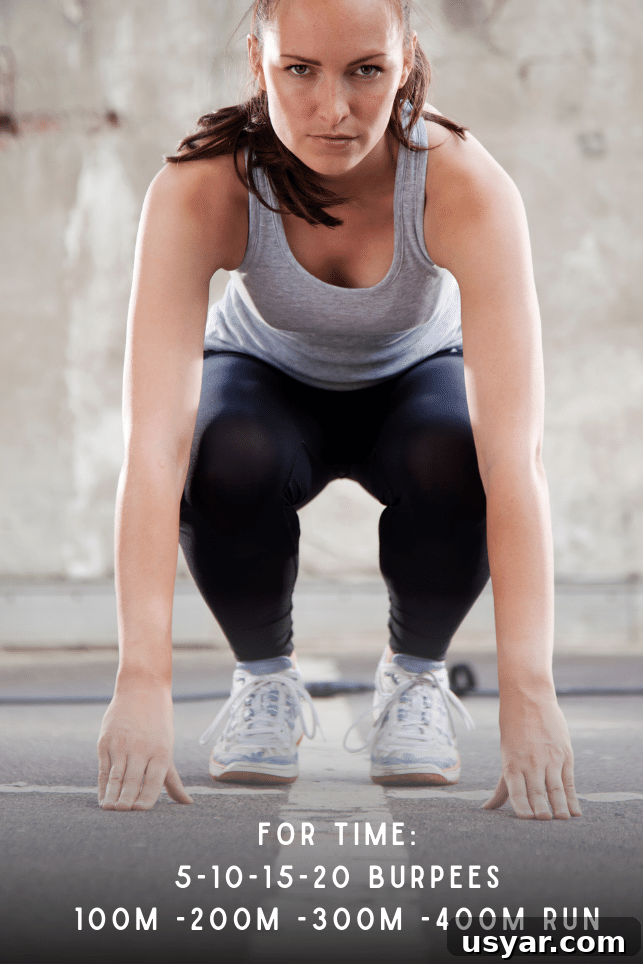
This workout alternates burpee sets with measured runs to build endurance, power, and conditioning. Before you begin, map out routes for the following distances: 100 meters, 200 meters, 300 meters, and 400 meters. When your timer starts, perform the sequence below without pausing the clock:
- 5 burpees, then run 100 meters
- 10 burpees, then run 200 meters
- 15 burpees, then run 300 meters
- 20 burpees, then run 400 meters
Move deliberately between the burpees and the runs, keeping transitions simple. Scale intensity based on fitness level and time available, but aim to maintain good movement quality throughout.
Equipment Needed
None. This routine requires no equipment—just a safe running route and a flat surface for burpees. If you prefer to track distances more precisely, a GPS watch or phone app can help, but it’s not required. Mark or mentally note turns so you can focus on effort rather than navigation.
Modification Options
Beginner: Modify burpees by stepping back into plank and stepping forward to stand rather than jumping. Reduce run distances (for example, cut each run in half) or alternate run/walk intervals if continuous running is too demanding. Rest 30–60 seconds between segments if needed.
Advanced: Increase the challenge by doubling burpee reps (10, 20, 30, 40) or by adding a plyometric jump at the end of each burpee. You can also extend each run by an additional 100 meters, or repeat the entire circuit for extra volume.
Warm-Up and Preparation
Spend 5–10 minutes warming up to reduce injury risk and improve performance. A simple warm-up could include light jogging, dynamic leg swings, hip openers, arm circles, and a few bodyweight squats and lunges. Do a couple of practice burpees at reduced intensity to groove the movement pattern before you start the timed set.
Cooldown and Recovery
After the workout, cool down with 5–10 minutes of easy walking or very light jogging to bring your heart rate down. Follow with gentle stretching for the hamstrings, quads, hips, chest, and shoulders. Hydrate and refuel with a balanced snack or meal containing carbohydrates and protein to support recovery.
Tips for Success
- Pace the runs: Treat the short runs as controlled efforts rather than all-out sprints unless you’re training specifically for speed.
- Maintain burpee form: Keep core braced, land softly, and manage breathing to avoid early fatigue.
- Choose safe routes: Avoid heavy traffic and uneven surfaces; if running outdoors is not an option, substitute brisk treadmill intervals or bike segments at comparable effort.
- Monitor intensity: Use perceived exertion or a heart rate monitor to keep the work challenging but sustainable.
Use code: weeklyworkout to save $5 on our 6 Week At Home Workout Program. This program complements minimal-equipment sessions and provides progressive structure for sustained results.
Interested in macro nutrition coaching? Learn more about our program and register through our coaching page to pair tailored nutrition guidance with your training for better results.