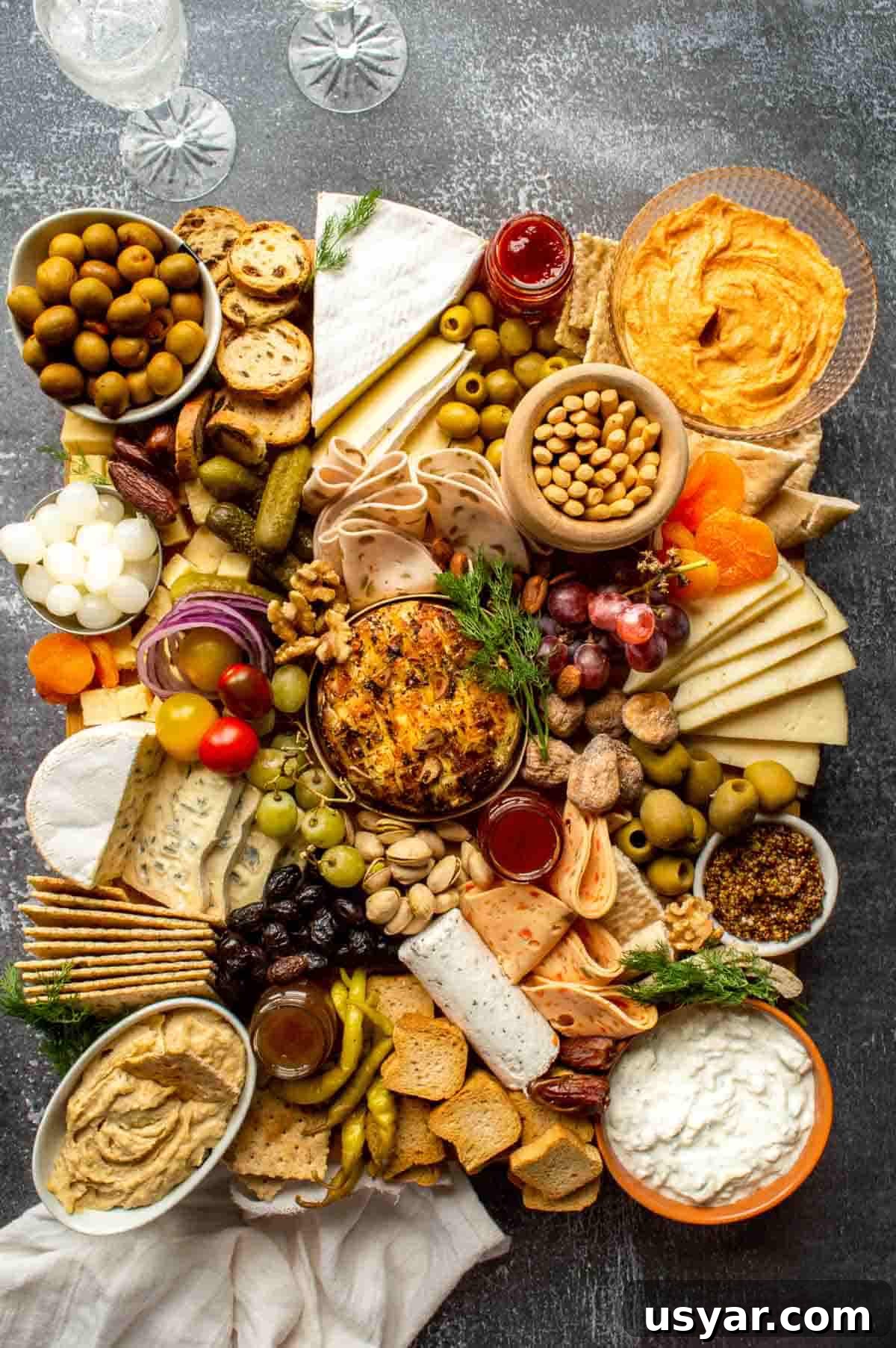
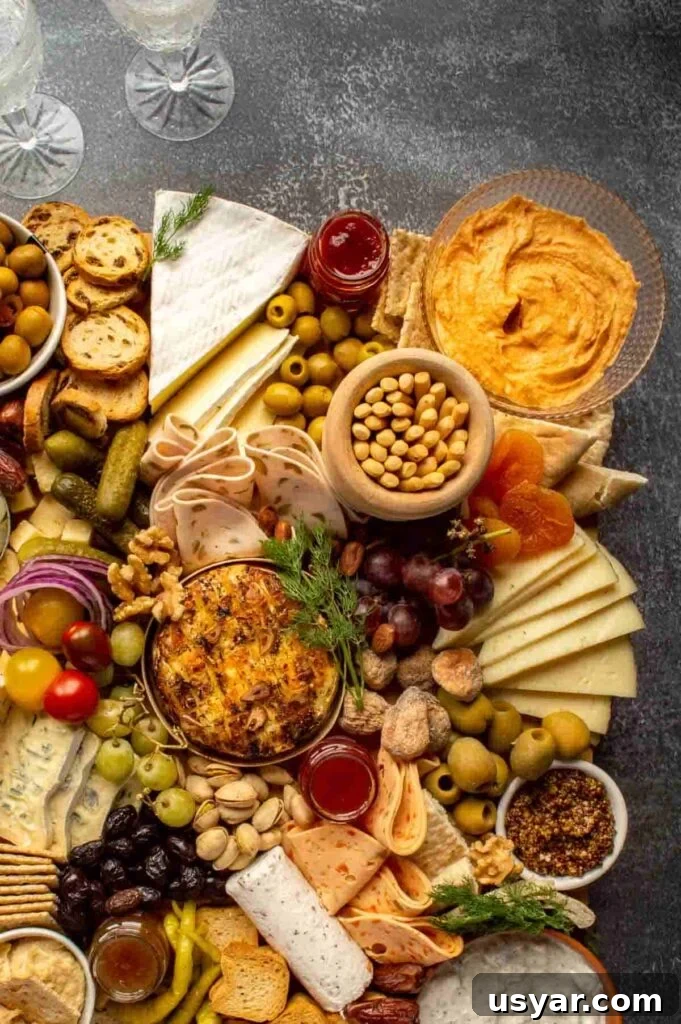
Enjoy this stylish, flavorful vegetarian charcuterie board—perfect as a shared appetizer, an impressive no-cook main for warm evenings, or part of a party or potluck spread.
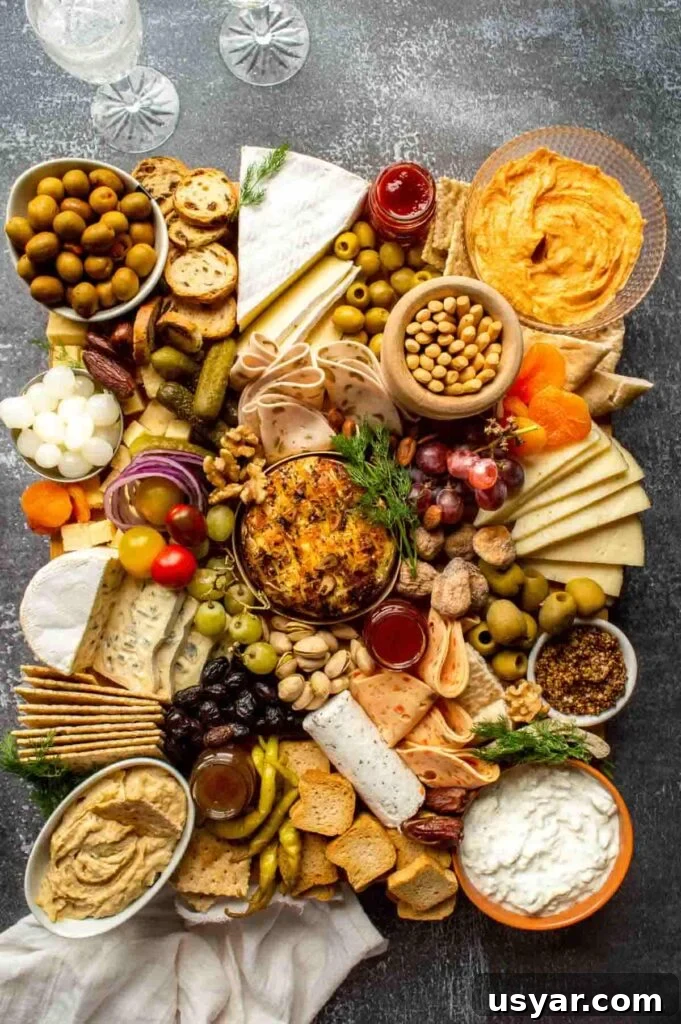
This attractive vegetarian board serves about six as a main (ideal for a light, heat-free summer meal) or 10–12 as an appetizer. Below you’ll find suggested quantities for smaller groups and clear, step-by-step instructions for assembling a balanced and visually appealing board that will delight both vegetarians and omnivores.
Charcuterie boards — even vegetarian versions — can be expensive if you buy specialty items. It’s perfectly fine to use supermarket staples and to raid your fridge, pantry, and fruit bowl for ingredients before shopping. For ease, many of these items are available pre-made, but you can also substitute homemade dips and spreads if you prefer.
This vegetarian board can easily be made vegan by swapping the cheeses for vegan cheese alternatives and checking that any plant-based deli items are fully vegan (some veggie mortadella or deli slices may contain egg).
- What is a charcuterie board?
- Foods to use on your vegetarian board
- How to put this board together
- Servings guide
- Other vegetarian boards you might like
- Recipe for this board
What is a charcuterie board?
A charcuterie board is an assembled platter of complementary items such as cheeses, breads or crackers, fruits, pickles, nuts, spreads, and often cured meats. The French term “charcuterie” refers to cured meat products, but a vegetarian charcuterie board replaces meat with vegetarian deli slices or omits it entirely—becoming essentially a cheese and accompaniments board.
Charcuterie boards pair beautifully with wine. In warm weather, choose chilled whites or sparkling wines such as cava, Albariño, or Verdejo. A crisp Sauvignon Blanc or a light Pinot Noir also works well. If you prefer a fuller red, try Rioja, Merlot, or Cabernet Sauvignon.
Foods to use on your vegetarian board
For a balanced vegetarian board, consider items from the categories below; aim for variety in texture, flavor, and color.
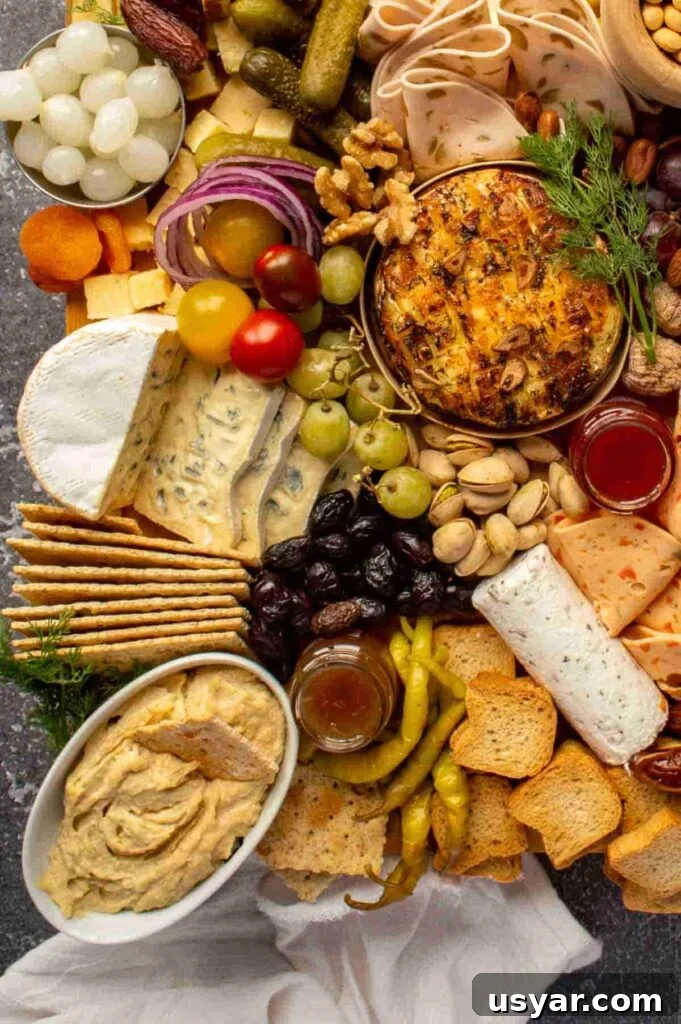
Cheeses: Include three to six different cheeses for most boards. Aim for contrasting textures and flavors: a couple of hard cheeses (e.g., manchego, aged cheddar, Gouda), one or two semi-soft cheeses, and one or two soft cheeses (e.g., brie, camembert). If you use two similar soft cheeses, consider preparing one differently—for example, baking and glazing a camembert so it tastes distinct.
To bake camembert: place the round in its wooden box (or a small oven-safe dish), remove the top rind, score the top, and drizzle with a little white wine, honey, olive oil, and sprinkle with black pepper, chili flakes, and dried thyme. Bake until soft and melty.
Dips and spreads: Include dips that pair well with vegetables and breads. Good options: hummus, tzatziki or snezhanka, cream cheese spreads, spicy feta dip (tirokafteri), chunky salsa, garlic aioli, baba ganoush, or tapenade. Use small bowls or jars for these.
Crackers, breads, and breadsticks: Provide at least two to three different types for texture: thin wholewheat or seed crackers, salted crackers, mini toasts, and a crusty baguette sliced thin. Small breadsticks or mini grissini add height and crunch.
Pickles and olives: Variety is key—include at least three types. Think stuffed or pitted olives, green and black olives, gherkins, pickled onions, pickled peppers, mini pickled eggplants, or white asparagus. For visual interest and palate cleansing, mix sizes and colors.
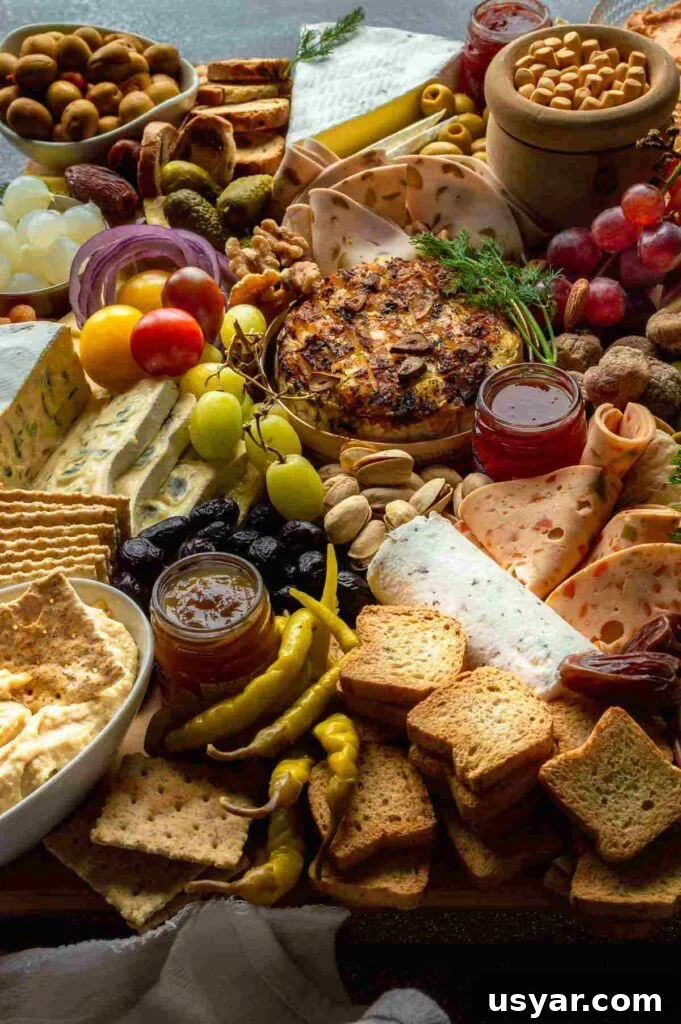
Jams, chutneys, and mustards: Add at least three condiments to enhance cheese pairings—examples include tomato jam, red pepper jam, onion jam, blackberry jam, apple jam, caramelised onion chutney, spicy tomato chutney, mango chutney, and wholegrain mustard. Quince jelly is another elegant option.
Vegetarian deli slices (optional): If you include plant-based deli meats, choose two thin, sliceable varieties (mortadella-style, vegan chorizo, or salami alternatives) and arrange them folded or fanned for ease of serving.
Fruits and vegetables: These refresh the palate and add color. Vegetables for dipping: carrot sticks, celery, cucumber, and pepper strips. Fruits to include: grapes, cherry tomatoes, sliced apples or pears (toss apple slices in lemon juice to prevent browning), berries, dried apricots, figs, and dates. Avocado slices are nice if served immediately.
Nuts: Add at least two types—one flavorful snack nut (pistachios, salted almonds, or toasted cashews) and one milder nut that pairs well with cheese (walnuts are classic).
Fresh herbs (optional): Small sprigs of rosemary, thyme, or dill make a pretty finishing touch.
How to put this board together
Follow these steps to assemble a balanced and attractive board. Substitute any ingredients you dislike and use seasonal produce where possible. For smaller boards, use fewer items—refer to the servings guide below for quantities.
0 – The base
Any large, flat surface works as a base: a wooden board, serving platter, tray, or even the table lined with baking paper. If your board is not food-safe, line it with parchment paper. For a large board like the one shown, a 15 x 18.5-inch wooden board is ideal. Provide small forks or picks for olives and cubed cheese, and one knife per soft or crumbly cheese.
1 – Large cheeses and bowls
Start by placing large cheeses and bowls for wet items. These anchor the board and help you plan placement. Put one large item near the center and the others toward each corner or equidistant points on a round board. In the example shown, the centerpiece is a baked camembert, with bowls of marinated olives and three dips at the corners.
2 – Medium cheeses and bowls
Add medium cheeses between the larger anchors, staggered off-center for a natural look. Keep contrasting colors and textures apart so similar items don’t sit next to each other. Example cheeses used: brie, manchego, herbed goat cheese, and a blue cheese.
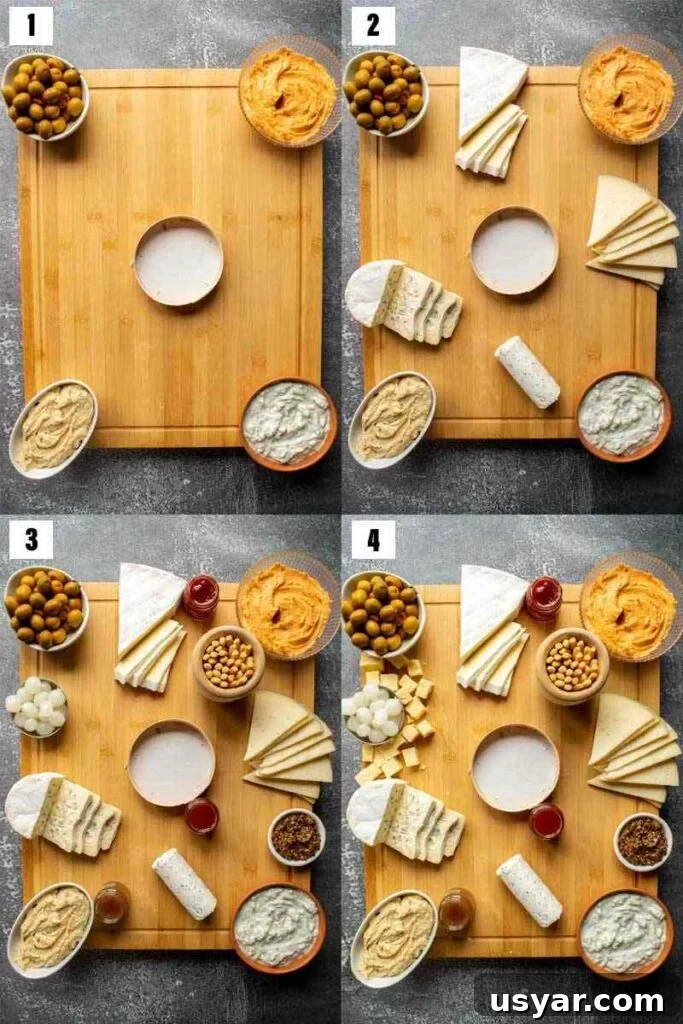
3 – Small bowls
Place small bowls or jars of jams, mustards, and pickled items around the larger elements. Use a glass or ramekin for breadsticks so they stand upright. Distribute small bowls evenly and avoid placing items of the same color next to each other.
4 – Cubed cheeses
Add cubed cheeses in small piles or semicircles around a bowl or edge. Cubed aged cheddar or similar hard cheeses work well here.
5 – Crackers, breadsticks and breads
Fill gaps at the board’s edges with crackers and bread. Use a variety across different edges to provide texture and keep items from clustering.
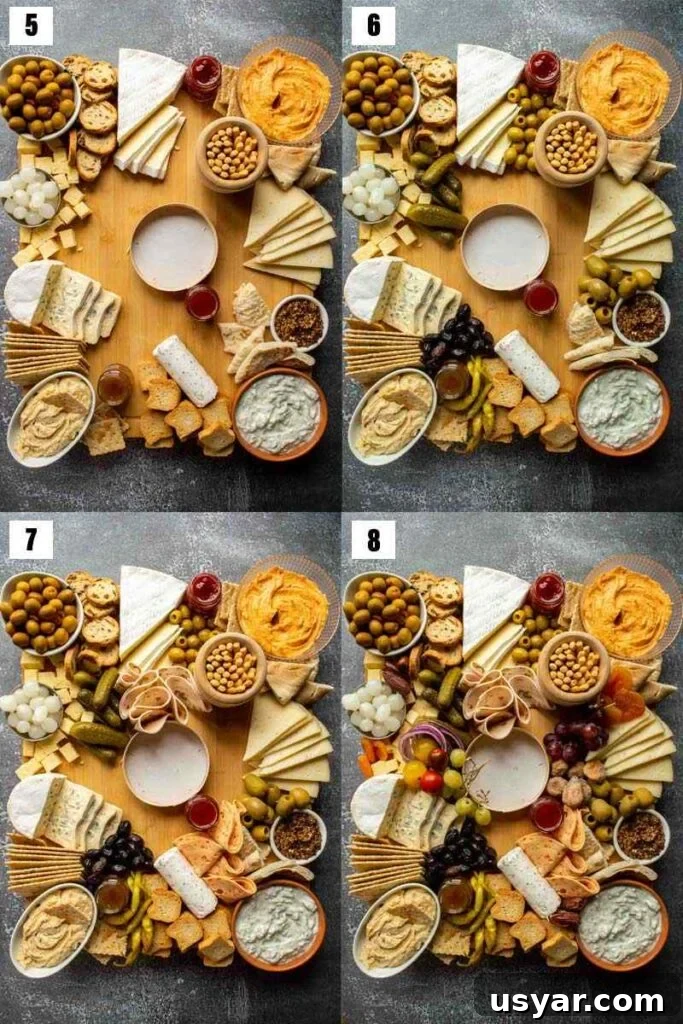
6 – Pickles and olives
Scatter different pickles and olives around the board, spacing colors and types so similar items are not adjacent. Fill remaining edge gaps first, then work inward.
7 – Vegetarian deli slices (optional)
If using thin vegetarian slices, fold them into quarters and tuck them into small nests on the board. For thicker plant-based sausages, slice and fan them around other items.
8 – Fruit and vegetables
Fill the center and remaining spaces with fruit and vegetables, leaving several spots open for nuts. Use a mix of fresh and dried fruits to add sweetness and chew.
9 – Nuts and finishing touches
Fill the last gaps with nuts such as pistachios, almonds, and walnuts. Optionally tuck a few herb sprigs (dill, rosemary, thyme) around the board for color. Replace any placeholders (for example, a lid used while building) with the final cheese or centerpiece.
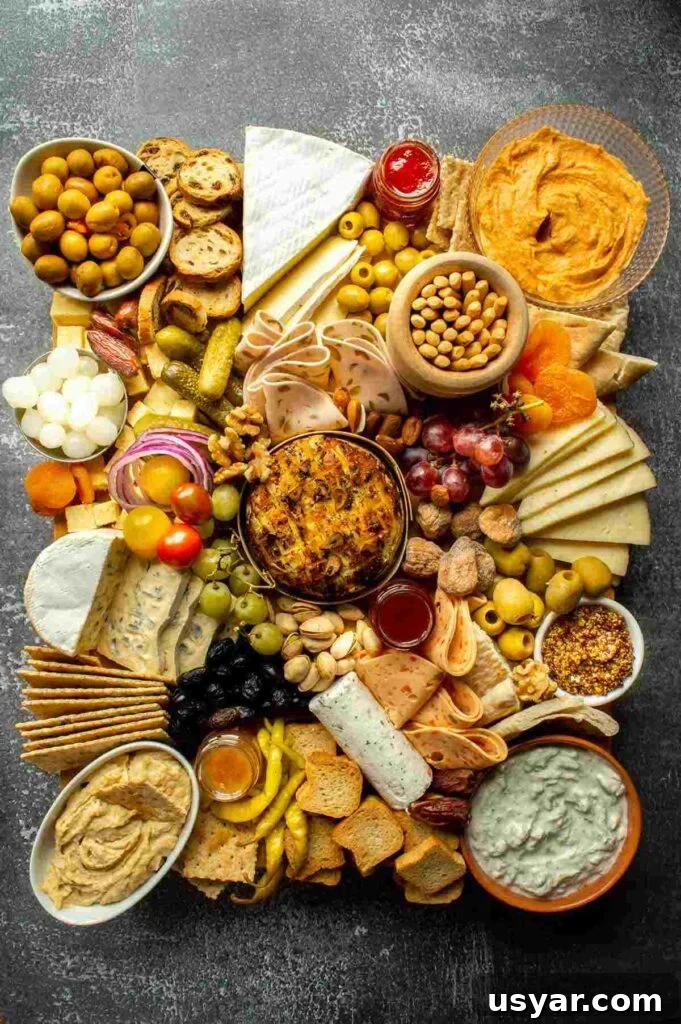
Servings guide
Quantities depend on how substantial other board items are and your guests’ appetites. As a rule of thumb, plan roughly 2–3 ounces per person of cheeses and dips for an appetizer, or about 6 ounces per person if the board is the main course. Crackers and bread can be estimated as a large handful per person.
When in doubt, err on the side of more food—many items (pickles, crackers, breadsticks) store well, cheeses and dips keep in the fridge for several days, and leftovers make easy meals.
| Group Size | Cheeses | Dips/Spreads | Crackers etc. | Pickles/olives | Jams/sauces | Vegetarian deli | Fruit & veg | Nuts |
| 1 | 3 types, ~2 oz each | 1 type, ~1 oz | 2 types | 2 types | 2 types | optional | 2 types | 2 types |
| 2 | 3 types, ~5 oz total | 2 types, ~2 oz | 2 types | 3 types | 2 types | 2 types | 3 types | 2 types |
| 4 | 4–5 types, ~8 oz total | 2–3 types, ~4 oz | 3 types | 4 types | 3 types | 2 types | 4–5 types | 3 types |
| 6 | 5–6 types, ~11 oz total | 3 types, ~5 oz | 4 types | 4 types | 3 types | 2 types | 5–6 types | 3 types |
| 10 | 6 types, ~18 oz total | 3–4 types, ~7 oz | 4 types | 5 types | 4 types | 3 types | 6–7 types | 4 types |
Other vegetarian boards you might like
Charcuterie-style boards can be adapted for any season or occasion. Consider variations such as a rainbow fruit-and-vegetable platter with hummus, a Mediterranean hummus mezze, seasonal cheese boards for spring or autumn, or even dessert and brunch-style boards with pancakes or waffles.
Did you make this vegetarian charcuterie board? Share how you liked it with a rating or comment, or post a photo on social media and tag the creator to show your version.
📖 Recipe
Epic Vegetarian Charcuterie Board
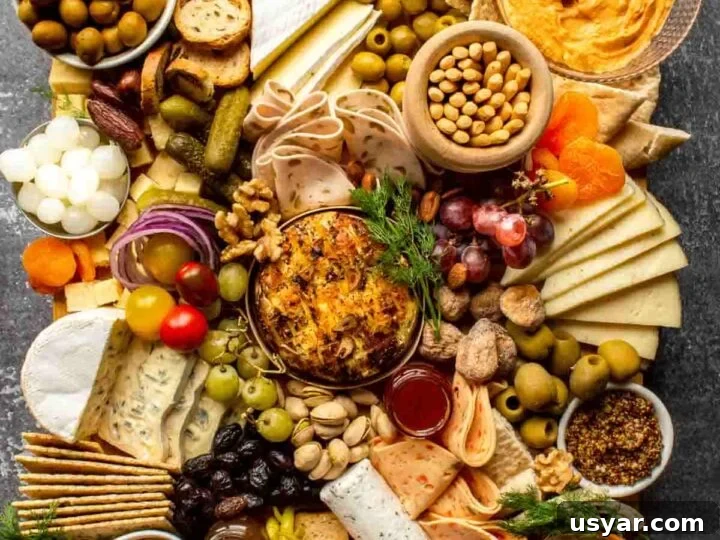
This epic vegetarian charcuterie board is great for entertaining or as a no-cook summer dinner. Ingredients are listed roughly in the order they are added to the board. Adjust quantities and varieties to suit your tastes and what you have available.
30 minutes
30 minutes
Ingredients
Step one
- 6 oz Camembert
- 3 dips/spreads (examples: hummus, red pepper hummus, tzatziki)
- Marinated olives
Step two
- Four types of cheese, about 4 oz each (for example: brie, manchego, herbed goat cheese, blue cheese)
Step three
- 3 types of jam or chutney (mini jars are handy)
- Breadsticks or mini grissini, about 1 cup
- Wholegrain mustard
- Pickled pearl onions
Step four
- 2 oz cubed cheddar (or similar)
Step five
- 4 types of crackers or breads, around 5 cups total (mini raisin toasts, wholegrain crackers, pita chips, melba toasts)
Step six
- 5 types of pickles/olives (a handful each) — gherkins, stuffed olives, large gordal olives, pickled Basque peppers, black olives
Step seven (optional)
- Two types of vegetarian deli slices (mortadella, chorizo, or salami alternatives), 6–8 slices each
Step eight
- Five types of fruit and/or veg, dried or fresh, a small handful each (cherry tomatoes, red and white grapes, dried apricots, dates)
Step nine
- 3 types of nuts, about 3 tablespoons each (pistachios, walnuts, almonds)
- Optional: fresh herbs for garnish (dill, rosemary, thyme)
Instructions
- Place the camembert in the center of your board. If baking, use a lid or placeholder while you assemble the rest of the board.
- Set dips and marinated olives in bowls at four corner points to anchor the layout.
- Add the four kinds of cheese between the corner bowls, staggered slightly off-center for a natural look.
- Place small bowls or jars of jams, mustard, and pickled items around larger pieces. Use a glass or ramekin for breadsticks so they stand upright.
- Cube a hard cheese like cheddar and pile it near an edge bowl in a semicircle.
- Fill in edges with crackers and breads to create structure and stop smaller items from sliding off.
- Scatter pickles and olives around the board, spacing colors and types apart.
- If using vegetarian deli slices, fold or fan them into small groups placed around the board.
- Add fruit and vegetables, leaving several open spots for nuts.
- Fill remaining spaces with nuts and finish with a few herb sprigs for garnish.
Nutrition Information (per serving)
Yield: 6 Serving Size: 1
Calories: 534 | Total Fat: 34g | Saturated Fat: 14g | Unsaturated Fat: 17g | Cholesterol: 64mg | Sodium: 1245mg | Carbohydrates: 41g | Fiber: 5g | Sugar: 21g | Protein: 20g