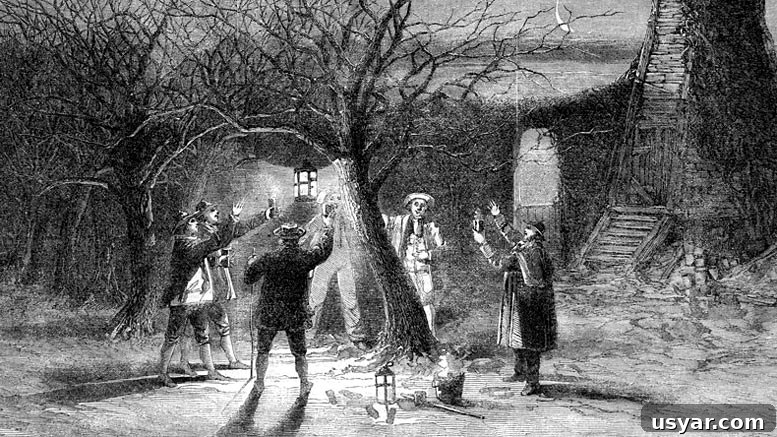
Traditional Wassailing In An Orchard (Apple Howling)
Wassailing is an age-old custom of blessing land, homes, farms and orchards to encourage health and abundance in the coming year. Its roots reach back to pre-Christian, pagan practices that mark the return of life after winter and seek a fruitful harvest—particularly apples and pears in orchards. Today wassailing is most commonly observed around mid-winter, often on Twelfth Night (the evening of January 5th) or on the traditional (old style) Twelfth Night of January 17th, though local customs vary across regions.
Definitions from English folklore
Folklore scholars distinguish two main types of wassailing: a house-visiting custom in which neighbours are wished health and offered spiced drink, and a field- or orchard-visiting custom aimed at blessing fruit trees and encouraging good crops. The name itself appears in various forms—wassail, waysailing, howling—and the practice was typically observed at Christmas or New Year.
House-visiting Wassail
The house-visiting tradition involved groups, often of young women, carrying a decorated bowl of spiced ale or cider from door to door. The shared drink—commonly called lambswool—was served in a bowl adorned with ribbons and sometimes with a symbolic apple. Participants sang seasonal verses, offered good wishes and sometimes collected money to cover the costs of the feast. These rounds reinforced neighbourly bonds and celebrated community during the dark mid-winter period.
Orchard or Field Wassailing
The orchard version tended to be a male-dominated ritual focused on apple trees. Participants visited orchards to sing to the trees, beat trunks with sticks, splash cider around the roots and hang cider-soaked toast in branches. These actions were intended to drive off evil spirits, awaken the trees from dormancy and encourage a generous crop the following season. Traditional chants and shouts—often culminating in cheers—accompanied the ceremony.
Lambswool and the Wassail Bowl
Lambswool is one of the classic wassail drinks. Historically made from hot ale or cider mixed with roasted apples, sugar and spices, its frothy surface or apple-based origins are commonly cited as explanations for the name. Across centuries, the communal wassail bowl remained central: filled and shared among participants as part of the ritual, sometimes becoming an emblematic or ceremonial vessel at feasts.
Origins and Etymology
The word “wassail” derives from Old English wæs (þu) hæl, meaning “be healthy” or “be whole,” a greeting that survives in the modern phrase “hale and hearty.” Documentary references to wassailing appear from the late fifteenth century, and the celebration continued to evolve through the early modern period into the present day.
How to Wassail (A Practical Guide)
If you wish to observe a traditional wassail, gather friends and family on Twelfth Night or another chosen mid-winter date. Toast a thick slice of rustic bread and place it in a communal bowl. Prepare lambswool—hot spiced ale or cider with roasted apples—and pour it into the bowl. Carry the bowl outside along with lighted torches, pots and pans or wooden spoons to make noise. Sing, shout “wassail!” and make light and sound around the orchard to symbolically banish the spirits of the old year.
After sharing the drink from the communal bowl, pour a little of the lambswool and the soggy toast around the roots of a chosen tree as an offering, and hang fresh pieces of toast dipped in the drink among the branches. Be respectful of the trees and the land when performing these gestures—use small, symbolic offerings rather than anything that could damage living wood.
Traditional Verses
Short, rhythmic verses were traditionally sung during both house- and orchard-wassails. Examples commonly heard in English regions include:
- “Wassail, wassail, all over the town; Our toast is white, our ale is brown.”
- “Here stands a good apple tree, stand fast root, Every little twig bear an apple big, Hats full, caps full, and three score sacks full, Hip! Hip! Hurrah!”
Survival and Modern Practice
Wassailing has endured into the present, especially in cider-producing areas such as parts of the English West Country, where it remains a popular seasonal celebration. Modern wassail events often blend historical ritual with community gatherings—keeping the spirit of blessing orchards, sharing lambswool and singing together while inviting a new generation to take part in a living tradition.